
Lodi lives outdoors from April through October, and the delta breeze is the reason. Afternoons here can sit near 100 degrees and then drop twenty degrees after sunset as air pulls in off the delta, which turns an ordinary backyard into the best room in the house by eight o clock. A landscape in this town should be built around that evening window.
Adams Pool & Landscape Specialties works throughout Lodi on landscape design, planting, paver and concrete hardscaping, irrigation repair, grading, and drainage. Our crews stay with the company for the long run and bring more than 500 years of combined experience to the yards they build.
The town gives us a wide range to work with. There are Craftsman and Victorian homes on the older streets near downtown, postwar tracts filling the middle ring, and newer subdivisions on the west and north edges, each with its own set of quirks under the soil.
You are surrounded by vineyards, and the best Lodi backyards borrow from them. Gravel courtyards, olive and crape myrtle for structure, grapevines on an arbor, lavender and rosemary along a walkway, and a dining area sized for a long table all read naturally here in a way that a tropical theme never will. That vocabulary also happens to be low water, which suits the summers.
We design around how the light moves. Morning sun on a breakfast area, shade structures or canopy trees over the western exposure, and lighting that extends the space past dusk make the difference between a yard you look at and a yard you use. Vertical elements like arbors and pergolas do a lot of work on flat lots that otherwise have no shape.
Older properties near downtown come with mature trees that are worth designing around rather than removing. We plan beds and hardscape to respect existing root zones, and we choose understory plants that are content with dappled light instead of forcing full sun varieties into shade.
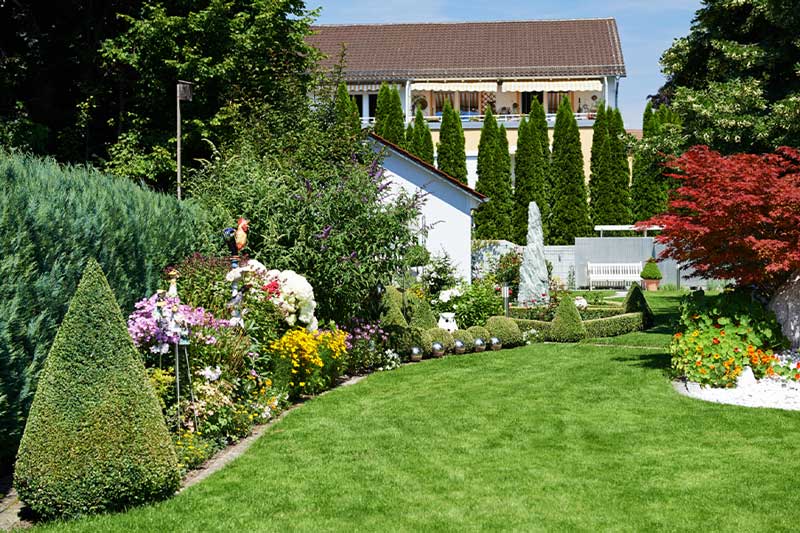
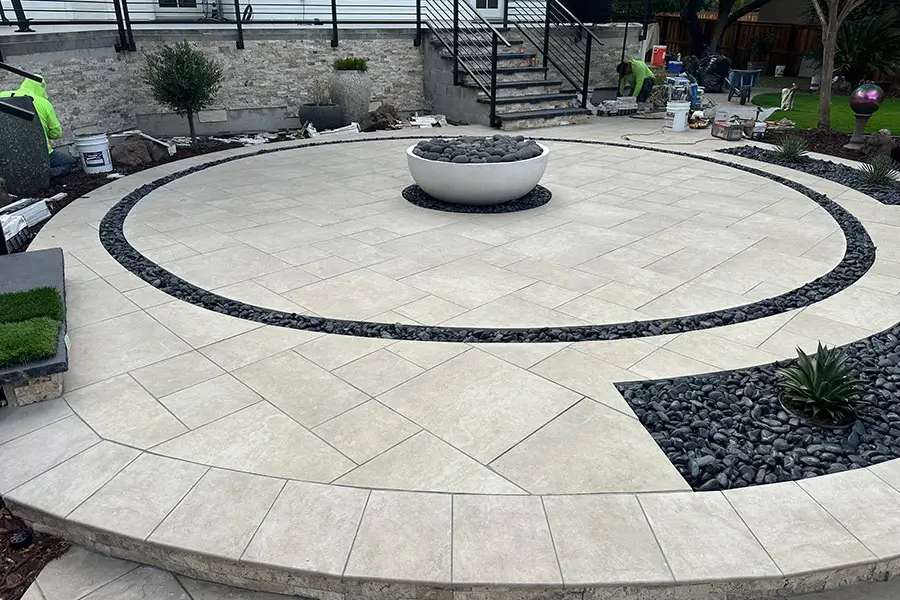
Lodi has real street tree canopy, and the flip side of all that shade is roots. Some of the most common hardscape problems in the older neighborhoods come from slabs and walkways poured decades ago over roots that have since doubled in size, lifting sections into trip hazards and cracking driveways at the joint.
Our approach is to work with the tree rather than through it. That can mean root pruning at a safe distance, floating a paver surface over a sand set base so it can be lifted and reset years from now, using flexible joints, or shifting the layout a few feet to clear the critical root zone. Pavers give a real advantage in these situations because a section can be pulled and re leveled without demolishing the whole patio.
Everywhere else, clay soil calls the shots. We excavate to proper depth, compact base in lifts, and set slope away from the structure so winter rain has somewhere to go. Skipping base work in this soil is why so many older patios in town have settled toward the house.
The soil under most of Lodi is dense clay that takes water in slowly and then holds onto it stubbornly. That combination frustrates homeowners in both directions. In summer, a long watering cycle runs off the surface before it soaks in, and in winter, the same ground stays saturated for days after a storm and drowns roots.
Fixing summer waste usually means splitting run times into shorter repeat cycles, switching to rotary nozzles or drip that apply water slowly, and correcting head spacing so coverage is even. Fixing winter saturation means restoring positive grade away from the house, adding French drains and catch basins in the low corners, and giving collected water an outlet that actually flows.
Several symptoms point straight at these issues.
When a yard shows a few of these together, the system and the grade usually need to be addressed at the same time.

Angela lives in the Lakewood neighborhood in a home built in the mid sixties, with a big elm out front and a back lawn that had never really thrived. Her sprinklers ran twenty five minutes a zone and she still had dry rings around the edges and a soggy strip along the back fence.
Running the system told us why. The clay could only absorb a few minutes of water at a time, so most of a long cycle was sheeting toward the back of the yard, which also happened to be the lowest point. The dry rings were coverage gaps from heads that had been buried by years of thatch.
The crew raised and respaced the heads, converted the zone to slower nozzles, and reprogrammed the controller for three short early morning cycles instead of one long one. We regraded the back strip, set a catch basin at the low corner with a line running out to the side yard, and reworked the front bed under the elm with shade tolerant plants on drip. Angela reported her summer water use dropped noticeably and the fence line finally stayed dry.
A good yard is a long relationship, not a one time transaction. Here is what we bring to Lodi properties.
Reach out when you are ready and we will walk the property with you.

Clay soil absorbs water slowly, so a long single cycle runs off before it can soak in. Splitting the same total time into several shorter cycles usually solves it without changing anything else.
Often yes. A sand set paver surface, careful layout around the critical root zone, and limited root pruning make it possible while protecting the tree. We assess each tree before committing to a design.
A wine country look works well. Gravel or decomposed granite paths, olive and crape myrtle, lavender, rosemary, and ornamental grasses fit the climate, need little water, and match the surrounding countryside.
Restoring grade away from the house and adding a catch basin or French drain at the low point handles most cases. The key is giving collected water an outlet with real fall to it.
Yes. We regularly work in Woodbridge, Acampo, Lockeford, Galt, and the surrounding San Joaquin County area. Share your address and we will confirm scheduling.
Estimated Monthly Payment