
Auburn is where the valley finally gives up and the foothills take over, and it seems like every yard in town sits on a slope. Add red clay soil, granite outcrops, and a wet year that can drop forty inches of rain, and hardscape has more working against it here than it does down in the flats. Water always finds the low side of an Auburn lot.
Adams Pool & Landscape Specialties installs paver patios, driveways, walkways, and pool decks throughout Auburn and the surrounding Placer County foothills. Grading and drainage come before anything decorative, because on a hillside those are the same problem. Built correctly, a paver surface here will outlast the roof on the house.
The first thing pavers do on a foothill lot is create flat, usable ground where there was none. Terracing a slope with paver landings and steps turns a hill you walk past into a place you actually sit. That is worth more in Auburn than in almost any other town we work.
Runoff is the next concern. Storms hit harder at this elevation and water sheets downhill fast, carrying soil with it. A properly pitched paver surface with open joints slows that water and directs it where you want, instead of letting it undercut a foundation or wash out a planting bed below.
Fire safety belongs in the conversation too. Pavers are non combustible, which makes them a practical surface in the zone right around the house where stone and gravel are the smarter choice over wood decking or bark mulch.
Freezing nights are the last piece. Auburn gets frost regularly and snow occasionally, and moisture that works into a concrete slab and freezes will eventually flake the surface apart. Jointed pavers give that moisture somewhere to go.

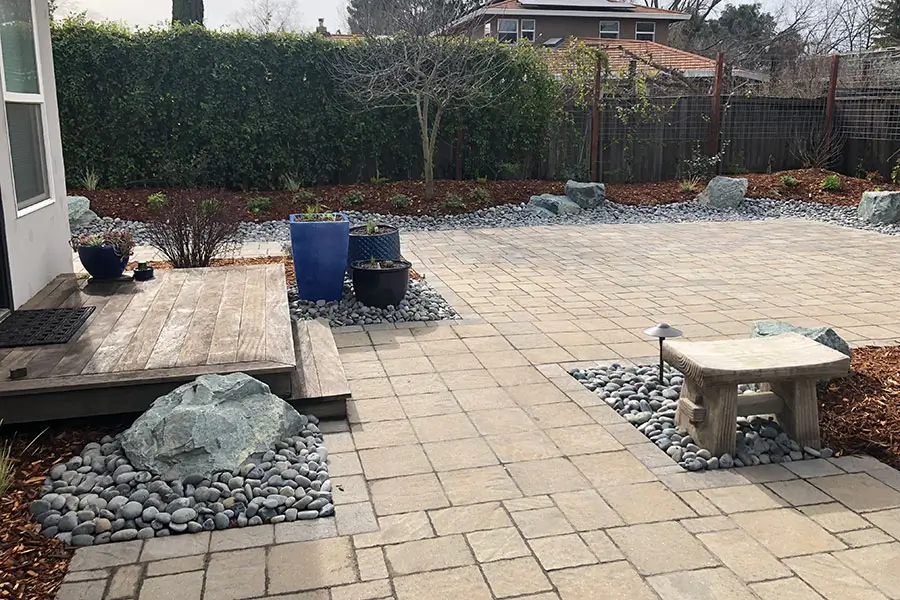
Auburn housing runs from Gold Rush era cottages near Old Town to custom homes tucked back in the oaks, so material choice varies more here than in a tract neighborhood. These are the paver styles that come up most in foothill projects.
We look at the house, the trees, and the grade together before recommending anything, since a paver that flatters a Victorian will fight a modern hillside build.
Sloped lots call for a different order of operations than flat ones. We start with a site walk focused on where water enters the property, where it leaves, and how equipment can even reach the work area. Narrow driveways and steep side yards decide a great deal about how a job gets built.
Grading and drainage go in before a single paver is placed. That can mean cutting a bench into the hillside, setting a retaining wall, or running a drain line out to daylight. Skipping this step is why so many foothill patios lean downhill within a couple of winters.
Base work follows, compacted in lifts and built thicker on the fill side where the ground is newer and less settled. Pavers are then laid, cut at every edge and step, and locked in with restraint around the open perimeter before joint sand goes in.
We finish with a full cleanup, haul off all spoil and old material, and walk the site with you while explaining what to watch for after the first heavy rain.
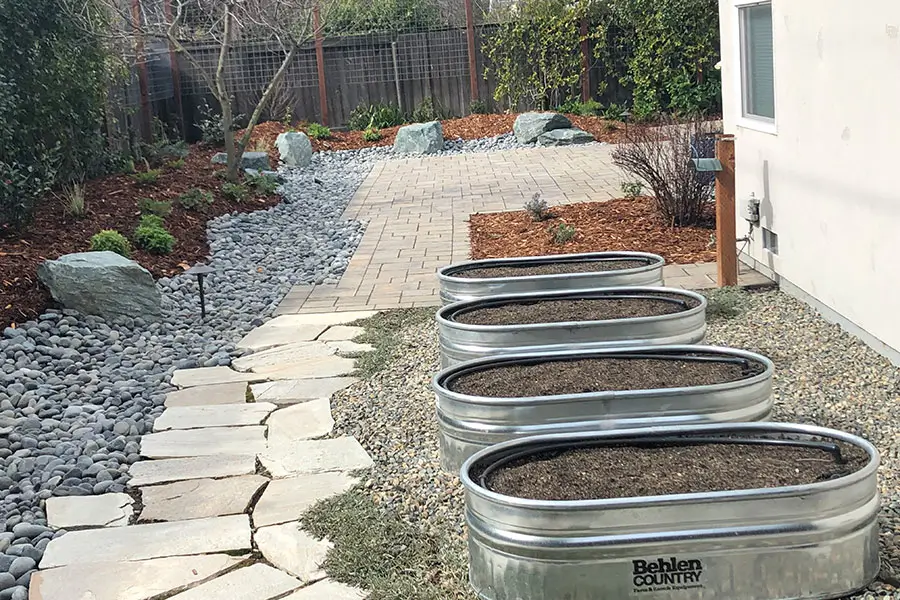
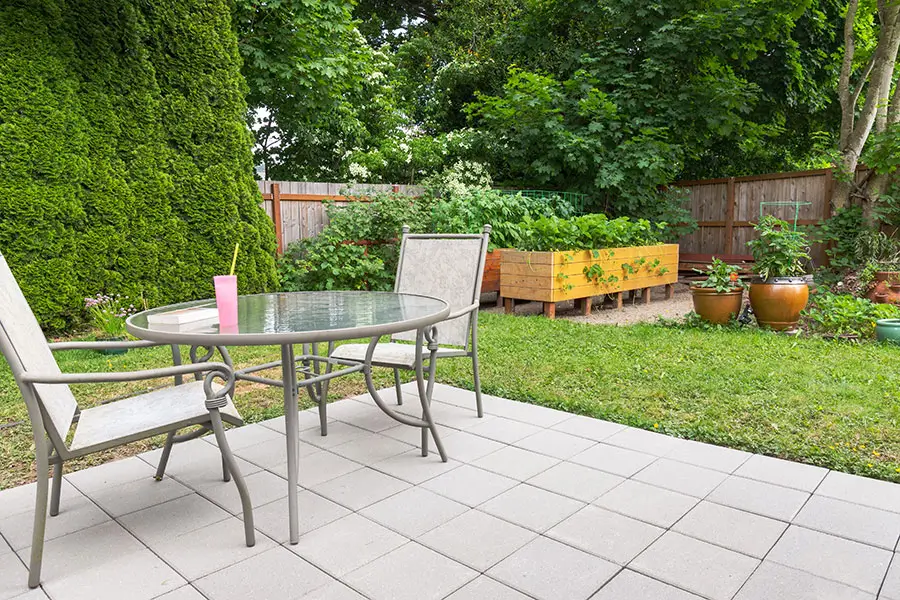
Karen called from the Skyridge area about a backyard she had basically given up on. The lot dropped away behind the house, the old concrete pad was pitched the wrong direction, and after every storm water ran across it and pooled against the back wall.
We pulled the pad, cut a level bench into the slope, and set a low wall to hold the uphill side. A drain line went in behind that wall to carry storm water past the patio rather than straight across it.
The finished space is a tumbled paver landing with three wide steps down to the lawn, framed by a border in a darker tone. Her old pad barely held a small table, and the new one seats a dozen people comfortably.
The real test came in February during several days of steady rain. Everything drained the way it was designed to and the back wall stayed dry.
Foothill work rewards experience, and here is what Auburn clients say made the difference for them.
We build for the wet season, not just for the photo taken the week we finish.
Estimated Monthly Payment